
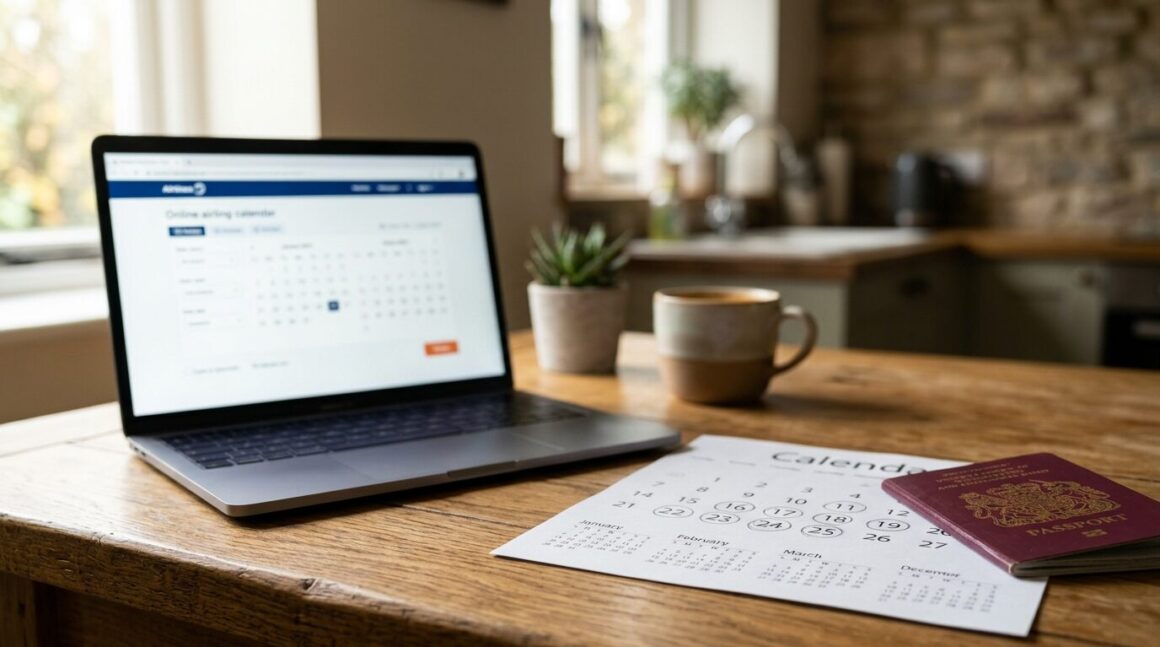
Partner reward seat on the airline’s own site but not on ba.com? Run the 355-day check before moving points into Avios
No, you can’t book it yet. Head for Points (HfP) reports that the British Airways booking system opens 355 days before departure, for cash and Avios tickets alike. It also reports that a partner airline showing reward seats earlier on its own website doesn’t change that. You can’t book those seats via BA with Avios until the 355-day point.
The partner’s calendar tells you the seat exists in that airline’s system today. It doesn’t tell you that ba.com will show the same seat when your date opens, what it will cost in Avios and cash, or that it will still be there. So, by default, keep your points where they are. Work out when your outbound and return dates enter ba.com’s window, and transfer only once ba.com shows the exact flights, cabin and total price you need. HfP does describe an exception for Qatar Airways, but using it means booking through a different programme rather than through ba.com.
Who controls the dates
Two separate calendars are involved. According to HfP, partner airlines set their own reward seat release schedules, and BA has no control over them. BA’s booking window is a separate limit. So when a partner releases space earlier than 355 days, you can see it on the partner’s site, but ba.com can’t sell you a seat on a date its system hasn’t opened.
BA’s Club factsheet says members can take reward flights on oneworld and other partner airlines “wherever there’s availability”, paying Avios plus cash for taxes, fees and carrier charges. That confirms partner rewards are bookable in principle, but it doesn’t say how much partner space ba.com displays, or when.
One caveat applies throughout. The 355-day figure comes from HfP’s September 2026 article, not from a BA-published rule, and none of the BA material checked for this piece states it. Treat it as a working assumption and let the ba.com calendar have the final word.
Step 1: find when your outbound date opens on ba.com
Count back 355 days from your departure date, then check that date on ba.com before relying on it, because the counting convention isn’t clear.

HfP’s own example says a flight on 20 April 2028 can be booked from 30 April 2027. Counted day by day, that gap is 356 days, because February 2028 has 29 days. Either the example counts inclusively, or the window differs by a day from the headline figure. Either way, your own arithmetic could be a day out, which matters if the seat is in demand.
In practice, calculate a target date and start checking ba.com a day or two before it. Search your exact date in ba.com’s reward search and note the first day it becomes selectable at all, whether or not the partner seat appears. That tells you the window has reached you. The evidence used here doesn’t cover what time of day partner space appears on ba.com, so don’t assume it matches the time BA releases its own seats.
Step 2: the return leg opens later
If you need a return, the inbound date enters ba.com’s window after the outbound does. On a two-week trip, that’s roughly two weeks later. Until then, you can’t price or book the whole trip on ba.com.
That forces a choice when the outbound opens. You can book the outbound alone and hope the return is available when its date opens. Or you can wait and book both together, accepting that someone else may take the outbound in the meantime.
HfP describes the outbound-first approach for BA’s own flights: book the outbound at release, then call back a few days later to add the return. It says BA doesn’t, “at the moment”, charge a change fee for this, as long as the return is added as soon as it’s released. That description covers BA-operated flights. The evidence used here doesn’t cover whether a partner return can be added to an existing partner award on the same terms.
If the return never appears, the fallback is BA’s general provision. The factsheet says changes or cancellations can be made up to 24 hours before a flight for a fee, without losing Avios. It doesn’t state the fee, and it doesn’t confirm that partner-operated awards follow the same rule. Before booking a one-way you’d be unhappy holding on its own, ask BA:
- Can a partner return be added to this booking later, and is there a charge for doing so?
- If I cancel this partner award, what is the fee, and do the Avios and taxes come back?
- Does the answer differ because the flight is operated by a partner rather than BA?
Step 3: what must be on the ba.com screen before you transfer
The default rule: move no points until the booking site you’ll actually use shows the exact itinerary at a price you accept. When ba.com opens your date, confirm each of these on screen:
- The same flight and operating carrier as the seat you saw on the partner’s site, with the same flight number and times. A different routing or a connection on another airline is a different trip.
- The date, checked against the calendar rather than your notes.
- The cabin. A business seat on the partner’s site doesn’t mean ba.com is showing business.
- The Avios price per passenger.
- The cash element for taxes, fees and carrier charges, which BA says partner rewards include.
- The total for every passenger. Search for the full party, because space for one doesn’t prove space for two.
- Both directions, if you need a return and its date has opened.
- Your actual shortfall: the total Avios required minus what’s already in your BA Club account.
If anything differs from what you expected, the decision changes. A higher price or a different cash charge might still be acceptable, but decide that with the real numbers in front of you, before any transfer.
Why the partner’s calendar proves less than it seems
It’s tempting to read an open seat on the partner’s site as a reservation waiting for you. The evidence supports something narrower. HfP’s point is about timing: the 355-day cap applies even when the partner shows seats earlier. Nothing in the evidence used here establishes that the same space will appear on ba.com once the window opens, or that ba.com will price it the same way.
Partners set their own release schedules, and a seat seen on day 361 can be gone by day 355. The evidence used here doesn’t cover how much space a partner makes available to BA members, either. An early sighting is mainly useful as a signal of which dates to watch, not as a reason to move points into Avios.
The Qatar exception, and what it actually involves
HfP reports that Qatar Airways Privilege Club lets its members book Qatar Airways reward seats at 361 days, six days before the same seats can be booked through ba.com. It also says you can move British Airways Avios into a Privilege Club account and book from there.
That is a genuine head start, but a limited one:
- HfP describes it for Qatar-operated flights booked through Privilege Club. Don’t assume other partners work the same way.
- It isn’t an early ba.com booking. You’d be booking under Qatar’s programme, on Qatar’s rules.
- The evidence used here doesn’t cover Qatar’s taxes and charges on these bookings, its change rules, how long the transfer takes, what linking is required, or whether the move can be reversed.
The same on-screen rule applies. Before moving Avios to Qatar, confirm on Qatar’s site that the flight you can book now is bookable with Avios in your cabin, for every passenger, at a total you accept. The head start applies to each leg separately, so a return still opens later than the outbound and the one-way risk in step 2 applies here too. Then ask Qatar or BA how long the transfer takes and whether it can be undone, and assume it can’t unless the terms say otherwise. If the seat isn’t Qatar-operated, this path doesn’t apply and you’re back to waiting for ba.com.
Link early, transfer late, move only the gap
The evidence used here doesn’t cover transfer times, linking rules or whether transfers can be reversed, and that uncertainty shapes the sensible order of steps.
If you’ll be topping up from Amex Membership Rewards, or moving Avios between programmes, find out what linking involves and get it done well before your date opens, so the only task left on the day is the transfer itself.
By default, transfer only once the seat is priced on screen, and only the shortfall you worked out in step 3. Points moved earlier may be stuck in a programme for a booking you can’t yet make, for a seat that may not appear. We’ve set out the wider case, including two narrow exceptions, in the case against speculative transfers. One is a transfer bonus at a programme you’d use anyway. If a Membership Rewards bonus is running, this calculation shows how much it actually saves on the Avios you need to move, and when it saves nothing.
Because you don’t know how long a transfer takes, there could be a gap between seeing the seat and being able to pay for it. Ask your transfer partner about timing before your window opens, not on the day. If the answer means the seat could sell before your points arrive, that is the other narrow exception: consider moving ahead only Avios you’d use in BA Club even if this seat never appears, and leave the rest where it is.
A worked example: a seat seen six days too early
Everything in this scenario is hypothetical: the dates, the seat and the partner. It also assumes the 355-day figure applies exactly, so a real opening date could fall a day either side.
On 5 November 2026 you spot business class reward space on a partner’s own website. The outbound is on 1 November 2027 and the return is on 15 November 2027. ba.com won’t let you select the outbound date yet.
| Date (hypothetical) | What’s happening | What you do |
|---|---|---|
| 5 Nov 2026 | Outbound is about 361 days away. ba.com’s window reaches roughly 26 Oct 2027. | Note the flight numbers and times. Link accounts if needed and ask about transfer timing. Transfer nothing, unless the slow-transfer case above applies. |
| Around 11 Nov 2026 | Outbound date should enter ba.com’s window. | Check ba.com from a day or two before. If the exact flight shows for your full party at an acceptable price, decide whether to book the outbound alone. |
| Around 25 Nov 2026 | Return date should enter the window. | Search the return. If you’re holding an outbound, ask BA about adding it to the booking. |
On 11 November there are four possible outcomes. If the flight isn’t there, the early sighting hasn’t helped, but you haven’t lost any points by keeping them where they were. If it’s there but the Avios or cash total, or the space for your full party, isn’t acceptable, don’t transfer; decide with those real numbers whether to wait for other dates or look elsewhere. If it’s there for your full party at a total you accept and you accept the one-way risk, transfer the shortfall for the outbound and book it. If it’s there at an acceptable total but you won’t hold a one-way, wait and accept that it may sell.
If the partner here were Qatar Airways, HfP’s 361-day figure would make only the 1 November outbound bookable through Privilege Club on 5 November. The 15 November return would open there around 19 November 2026, still six days before ba.com, so you’d face the same one-way choice as in step 2. The evidence used here doesn’t cover adding a return to a Privilege Club award or how long a BA-to-Qatar transfer takes, and a slow transfer could use up some or all of the six-day head start. Before moving Avios for the outbound, confirm it on Qatar’s site and decide whether you’d hold it alone, then check the return when its date opens.
What the sources don’t settle
Several practical questions remain open. The evidence used here doesn’t settle:
- Whether ba.com opens dates at exactly 355 days, or 356 under some counting convention, and at what time of day partner space appears.
- Whether partner space seen early on the partner’s site reliably appears on ba.com, and whether it is priced the same.
- Whether partner awards follow BA’s 24-hour change and cancellation provision, and what the fee is.
- Whether a partner return can be added later to an outbound-only booking, and at what cost.
- How long Amex-to-BA and BA-to-Qatar transfers take, and whether either can be reversed.
- Which partners other than Qatar let their own members book earlier than 355 days.
The working answer still holds. As HfP reports it, ba.com won’t sell the seat until your date is 355 days out, give or take a day of counting. A partner’s earlier calendar shows only that the seat exists in the partner’s system. By default, confirm the exact itinerary and price on the booking site you’ll use before any points leave your account. If a slow transfer could cost you the seat, move ahead only Avios you’d use in BA Club anyway. Treat the Qatar route as a separate booking with its own checks.


You May Also Like

Get the Equivalent of BA Bronze Status for £38 Using Your Hotel Elite Status!
Amex Cashback vs Hotel Status: Are the 2026 Melia & Jumeirah Offers Worth It?